




Authentic villages
Traditional housing is an important part of the local heritage. Marennes-Oléron is home to several types of buildings: the peasant house, the fisherman's cottage, the seaside villa and the manor house.
Villages with unique charms
The former is characterized by its exterior staircase leading to the single storey, as seen in the hamlet of Les Allassins or La Brée-les-Bains. The latter served as a granary for storing crops and also provided thermal insulation. In the Marennes basin, the rural house is made up of outbuildings forming a "querreux", a common courtyard, around a well.
The low-slung fisherman's house has walls whitewashed every spring with a mixture of lime and sand to protect it from rain and frost. The lower part of the house was covered with coaltar, a kind of tar used on the wet parts of boats to protect them from damp. The small village of Chaucre, in the commune of Saint-Georges d'Oléron, is one of the best examples of a fishing village.
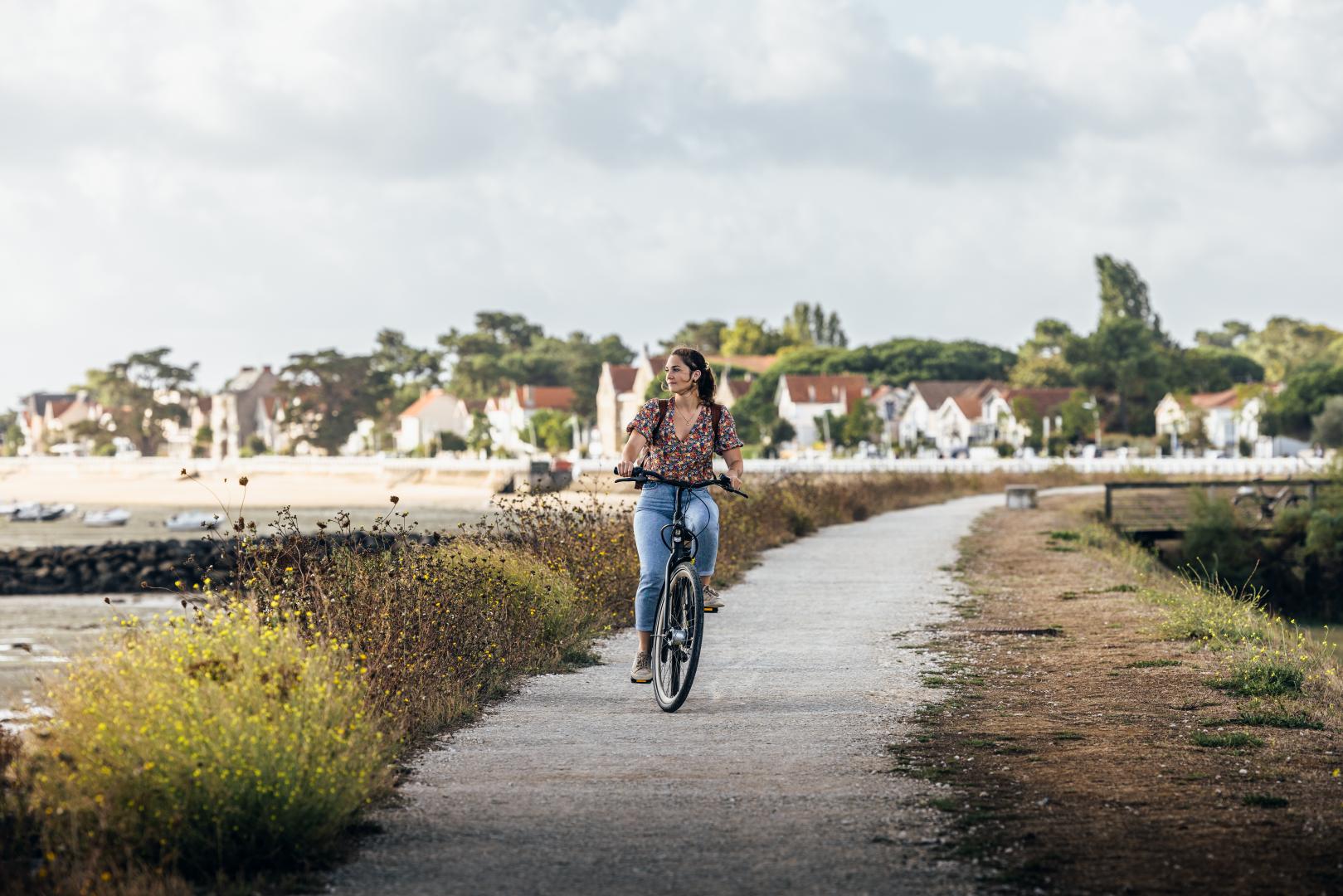
The mansions were generally part of a group of buildings used for winegrowing. Around 1880, following the introduction of the first steamboat links and the opening of the railroads, Saint-Trojan-les-Bains became a tourist destination. Under the name "Saint-Trojan-les-Bains", it became one of the most popular seaside resorts on the Ile d'Oléron.
Villas classified as "architecture balnéaire" (seaside architecture) dating from the early 20th century bear witness to the "bains de mer" (sea bathing) style of seaside architecture. Marennes, meanwhile, has long been a prosperous city, as evidenced by the mansions, noble and bourgeois houses built by shipowners and merchants as early as the 16th century.
From chai to saloches...
Also noteworthy are the many wine cellars, a kind of large wine storehouse used to store grapes and barrel wine. The wine trade is at the origin of international maritime law! First appearing at the end of the 3rd century, viticulture became the region's predominant activity in the Middle Ages. In the 18th century, the Charente region was referred to as the world's largest vineyard. It covered more than 200,000 hectares. At the end of the 19th century, phylloxera, previously unknown, spread and decimated almost all the vines in the region. Only those planted on sandy soils held out. Forced to sell their land, most of the large estates were bought up by former workers. As a result, cultivated land gradually shrank.
The region is home to numerous mills. These include the Moulin de la Plataine in Bourcefranc-le Chapus, a windmill dating back to 1650. The moulin de La Brée-les-Bains, located on "L'île aux 100 moulins", is a tower mill, equipped with a Berton system (wings made of wooden "lattes") during the 19th century. It has the particularity of being equipped with 2 pairs of millstones, and still possesses a large part of its mechanism. Since 2012, it has been the subject of a restoration project.
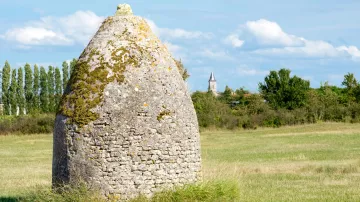
Witnesses to the oyster and salt industry are dotted around the local landscape, such as the "cabanes" and "saloches". In the Middle Ages, the salt extracted from Marennes-Oléron's many saltworks was internationally renowned, with many northern European countries sourcing their supplies here. Today, we don't know whether these shell-shaped turrets, built of rubble stone, were shelters for the "gabelous", customs officers who supervised the loading of salt, or whether they were used to store it? In any case, they surely served as a henhouse, supplementing the resources of the salt-maker. The mystery remains... These small buildings are located in Nieulle-sur-Seudre, the "Neuve-ville", and Le Gua.