




Fort Boyard
Since Fort Boyard is not open to the public, take advantage of a wide range of cruises departing from Île d’Oléron (Port de Saint-Denis d’Oléron or Boyardville) to get as close as possible to this majestic stone fortress. Through the many boat tours available, you can admire the Chassiron Lighthouse or stop off at Île d’Aix.
An Ambitious Project for Its Time
Located halfway between the islands of Aix andOléron, Fort Boyard was designed primarily to protect the harbor of Île d’Aix andthe royal arsenal at Rochefort. The range of the cannons at the time did not allow for crossfire between the fort in the harbor on Île d’Aix and the Saumonards battery on Île d’Oléron. Between the two islands lies the Longe de Boyard. The Dutch mapped this location as “Banjaert,” which translates to “sandbar” in Dutch and is the origin of the name “Boyard” used today .
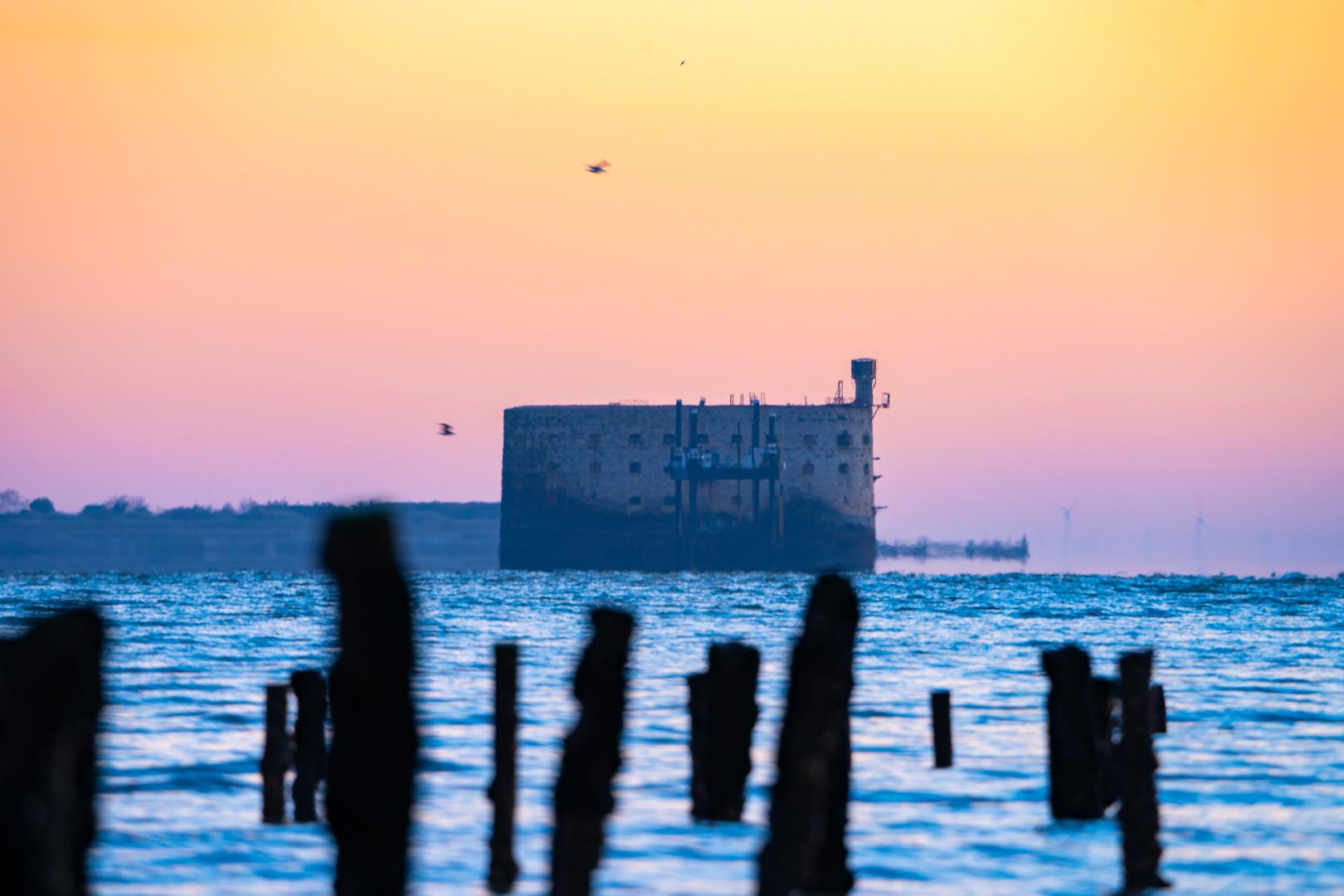
Plans to build Fort Boyard date back to the 17th century. As early as 1666, the creation of the Rochefort arsenal, ordered by Colbert, made military protection of this area essential. France had just emerged from the Seven Years’ War with England, and the defense of our coasts was therefore of paramount importance. However, faced with significant technical difficulties, the idea was repeatedly postponed. Vauban himself admitted he was powerless in the face of this challenge and addressed Louis XIV in these terms: “Sire, it would be easier to seize the moon with one’s teeth than to attempt such a task in this location.”
It was not until the early 19th century that the project was revived. In 1801, a joint commission composed of representatives from the Corps of Engineers, the Navy, and the Civil Engineering Corps submitted a report to Napoleon Bonaparte. The report recommended building a “stone vessel ” on the Boyard spit, following the Marquis de Montalembert’s ideas on fortification. In 1803, First Consul Bonaparte approved the project. That same year, the warehouses needed for the construction site and housing for the workers were established at the mouth of the La Perrotine channel, on the east coast of the Île d’Oléron. Boyardville was thus founded. Work on the dry-stone revetment began in 1804. Quarries were opened nearby, notably at the Coudepont headland on the island of Aix. The difficulties were immense, ranging from the rockfill collapsing to violent storms and the presence of the British enemy.
From darkness to light...
Construction came to a halt after more than 75,000m³ of stones had already been dumped onto the sandbar. Work resumed in 1809, based on a scaled-down design, but was suspended again that same year after the British destroyed the Rochefort squadron anchored in the harbor of Aix using fire ships. At that precise moment, 3,500,000 francs had already been invested in the project. Thirty years later, under Louis-Philippe, renewed tensions between France and England gave new impetus to the fort’s construction. In 1848, the base was built. Construction of the fort itself would take more than ten years. The total cost of the work is estimated at nearly 3,000,000 francs. The foundations are protected by a belt of Chausey granite. The upper section was built with stone from the Crazannes quarries, the vaults and interior with stone from Saint-Savinien, and the embrasures with brick. The work was completed in 1857 with the addition of the watchtower, which served as a semaphore station. Two years later, the fort was equipped with a breakwater to the north and a landing harbor to the south.
Did you know? The fort’s dimensions are truly impressive: 68 meters long, 32 meters wide, and 20 meters high. The fort was intended to be manned by 250 soldiers and armed with 74 cannons—as many as a three-deck warship. However, it ultimately received only about thirty.
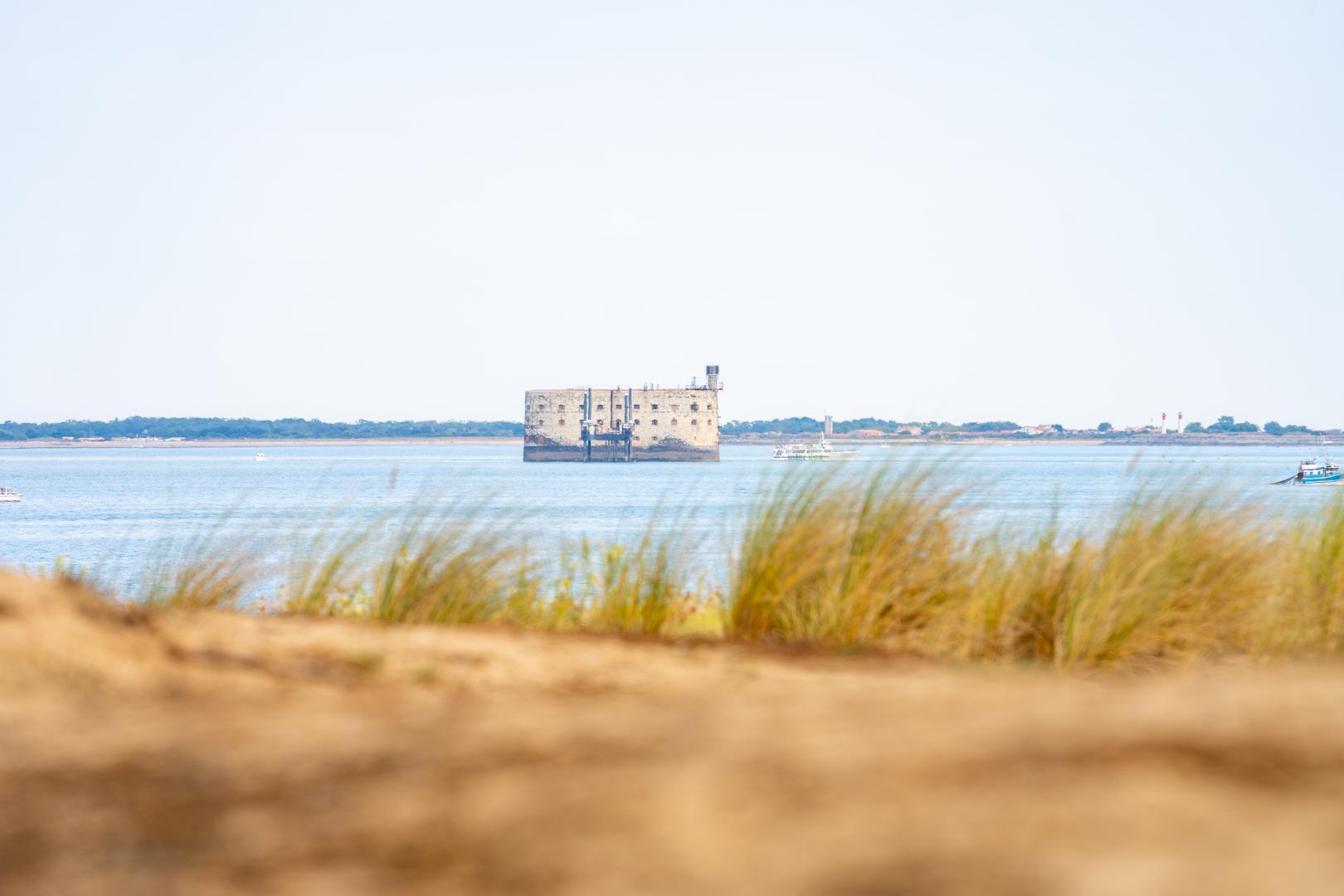
By the mid-19th century, advances in artillery—such as rifled cannons and the replacement of cannonballs with shells—rendered the fort obsolete almost as soon as it was completed. It was now possible to exchange fire between Oléron and Aix. At the end of the Second Empire, it became a military prison where Prussian and Austrian soldiers were held. Later, as a state prison for Communards, it held Louise Michel and Henri Rochefort before their transfer to the penal colony in New Caledonia.
In the early 20th century, left to decay, it fell prey to looters. In 1950, it was listed in the supplementary inventory of historic monuments. It was purchased in 1962 by a private individual at an auction held by the French State Property Office for 7,500 francs. In 1967, it served as the setting for the finale of Robert Enrico’s film *Les aventuriers*, starring Lino Ventura and Alain Delon. Television producer Jacques Antoine filmed the pilot episode of the game show *La chasse aux trésors*, hosted by Philippe Gildas and Philippe de Dieuleveult, there. The episode aired on September 6, 1981. Jacques Antoine eventually purchased it in 1988 for 1.5 million francs and sold it for a symbolic one franc to the Charente-Maritime General Council, while retaining exclusive rights to operate the Fort. Jacques Antoine, Jean-Pierre Mitrecey, and Pierre Launay created the game show *Les clés de Fort Boyard*. The first episode aired on July 7, 1990, and the concept was subsequently sold to some thirty different countries, making Fort Boyard famous around the world. A fitting turn of events for what was long nicknamed “the Fort of the Useless”!